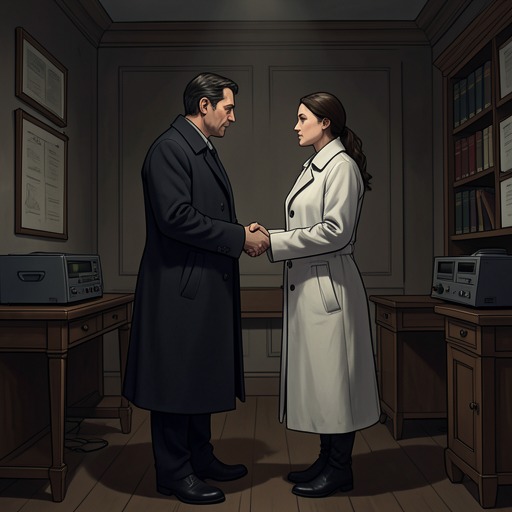
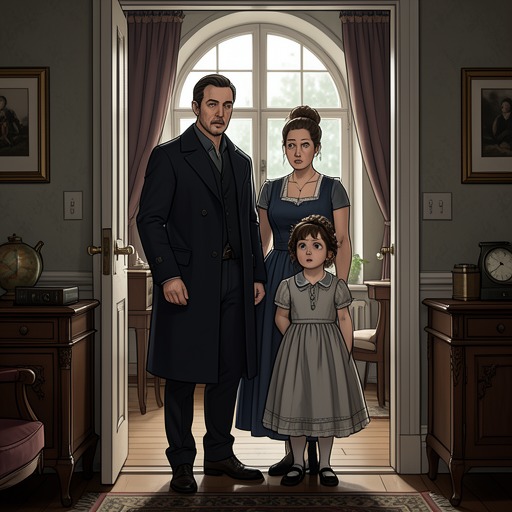
Lestat de Lioncourt—Mona Mayfair
Blood CanticleLestat de Lioncourt and Mona Mayfair share a maker-and-fledgling bond that becomes a demanding form of mutual care. Lestat understands his role as more than the one who transformed Mona: he is to guide and instruct her until she can live well on her own. Their relationship is strained when Mona, overwhelmed by her new powers and feelings, lashes out at Lestat over his love for Rowan. Its repair depends on candor, restraint, and Lestat’s insistence that the Blood does not release either of them from moral responsibility.
The Maker’s Responsibility
Lestat’s relationship with Mona is defined by an obligation he accepts after transforming her. When they confront the harm between them, he says that if he is to remain with her, he must be treated as the Master in their shared household. He resists having his authority repeatedly put on trial, but this demand is not the whole of his position: he also accepts that his own conduct requires correction. He admits that he lost his temper and played the power card just as Mona did, and says he should have shown greater patience.
That admission gives practical meaning to his stated duty. Lestat describes his task as guiding and instructing Mona, and staying with her until she can exist well on her own. The relationship therefore holds authority and care in tension. He expects her to trust his judgment, while recognizing that being her maker does not excuse him from self-restraint or accountability.
The Rupture Over Rowan
Mona explains that her harshness came from seeing Lestat’s love for Rowan and being frightened by it. Her confession reframes the conflict: her insults were not simply a rejection of Lestat’s authority, but an expression of fear about where she stood in relation to him. Lestat does not answer by denying his love for Rowan. Instead, he tells Mona that those feelings did not diminish his love for her, and that he had warned her to be patient with her family because he believed that was right.
He also identifies the circumstances surrounding Mona’s behavior. At the family gathering in the garden behind the First Street house—the place where the Taltos bodies had been buried—Mona was confronting matters that had tormented her for years while deluged with the gifts of vampirism and unable to modulate her feelings. That context helps explain the intensity of the rupture without making Lestat’s objections disappear: he had been trying to curb her insults toward people she loved, including Rowan and Michael, but acknowledges that he eventually answered her with mockery of his own.
Mona directly apologizes for her earlier abuse. She recognizes that she had spoken cruelly about Lestat’s other fledglings and old tragedies, and calls her behavior callous and morally crude, not an expression of her true nature. Her apology is specific: she names what she did and accepts that it was wrong. The scene shifts from a dispute over power and authority toward an attempt to understand what fear, grief, and new vampiric intensity had made each of them do.
The Blood and Moral Principle
Lestat’s answer to the conflict is not that vampirism places its practitioners beyond ordinary ethical limits. He tells Mona that they do not leave Natural Law behind when they receive the Blood, and that they remain creatures with principles. This conviction underpins his insistence that she treat Rowan, Michael, and Dolly Jean with respect rather than casually dismissing them as human beings. Quinn, too, has spent hours cautioning Mona about that manner of speech.
The exchange makes their bond a setting for moral instruction, but not a one-way lesson. Lestat’s demand that Mona trust his principles is paired with his acknowledgment that he acted wrongly when he lost patience and resorted to mockery. He does not claim that his love makes his conduct automatically right. Instead, the relationship’s repair requires him to exercise the restraint he asks of Mona and her to recognize the dignity of those affected by her behavior.
Care After Patsy’s Passing
The reconciliation follows a crisis involving Patsy, whose spirit Lestat helps pass into the Light. Afterward, Lestat refuses to relive what happened or explain what he saw. His refusal frustrates Mona, who asks him about the experience, and he sharply tells her that he does not want to speak of it. The exchange shows that care between them does not mean complete access: Lestat sets a boundary around an experience he considers closed, even as Mona and Quinn ask him to share it.
The strain eases when Lestat turns from accusation to reassurance. As Mona reflects on womanhood and the force of the powers she has been struggling to manage, he tells her not to keep battling herself. He then names his responsibility to guide her while admitting his failure of patience. Later, when Mona promises never to be mean to him again, Lestat says he believes her and that he took her to his heart from the first moment he saw her. When she asks what she can do to prove her love, he tells her she does not have to do anything. The ending rests not on a demand for proof, but on trust offered and accepted.
A Bond That Holds Difference
Lestat’s love for Mona exists alongside his love for Rowan, rather than replacing or canceling it. Mona’s fear of that attachment precipitates their quarrel; Lestat’s reassurance does not pretend that Rowan is unimportant. By affirming that his feelings for Rowan do not undo his love for Mona, he asks the relationship to withstand difference instead of relying on exclusive affection.
The bond is consequently neither simple dependence nor uncomplicated authority. Mona is Lestat’s fledgling, and he claims a guiding role; yet she can confront his emotional life, apologize for her choices, and ask what love requires, while he can admit fault and refuse to turn affection into a test. Their movement from cruelty and anger toward patience and trust gives the relationship its decisive shape: the maker’s responsibility is not merely to wield power, but to remain present as the fledgling learns how to live with it.